
What Carl Rogers, Mister Rogers, and Carl Sagan Have in Common

By Nancy Piccicuto, LCSW-C
There is probably something mildly revealing about the fact that three of my favorite people are Carl Rogers, Mister Rogers, and Carl Sagan.
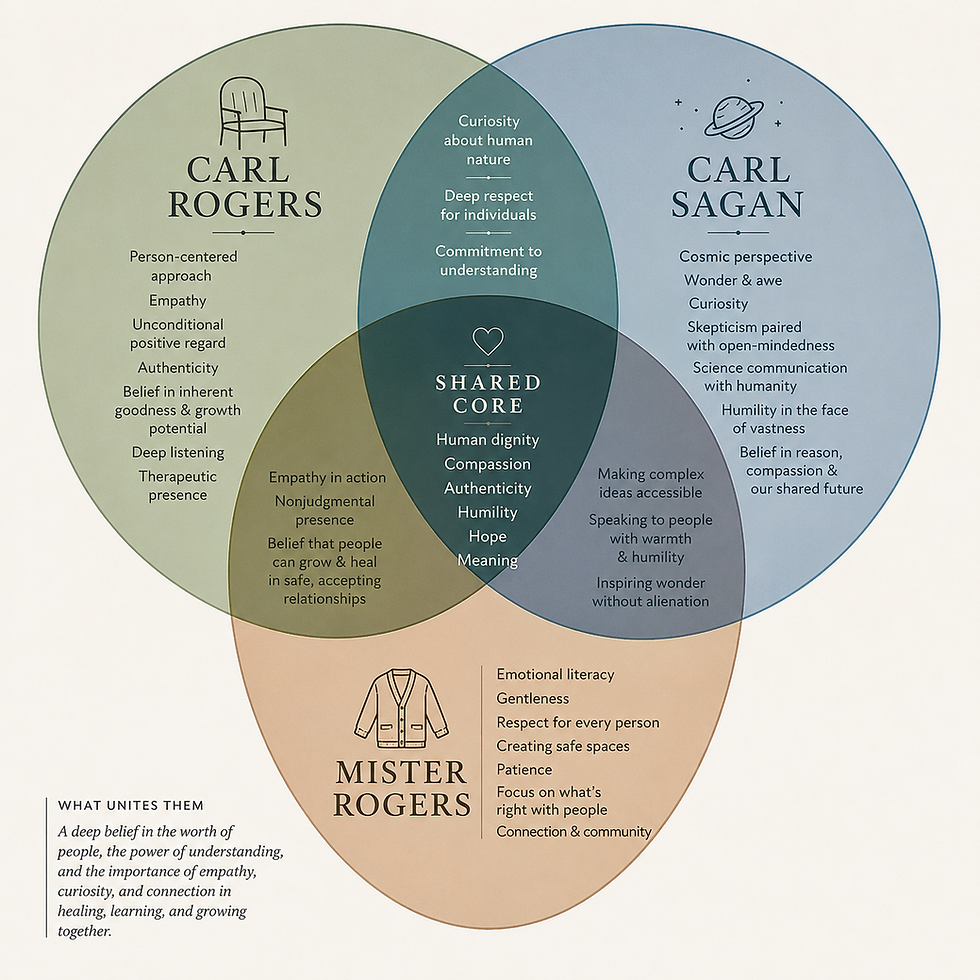
One was a psychologist, one wore cardigans and quietly reshaped children’s television, and one spent his career explaining the cosmos with the emotional tone of a deeply kind alien anthropologist. To me, though, they all share something essential.
They approached people with curiosity and dignity.
That sounds simple, but it actually feels increasingly rare.
We live in a culture that is very eager to diagnose, optimize, brand, critique, and oversimplify human beings. There is an enormous appetite for certainty, especially about other people’s lives. Entire corners of the internet are devoted to reducing complex emotional experiences into bite sized explanations and “fixes,” preferably delivered in under three minutes by someone drinking a green powder and proclaiming excellent gut health.
Meanwhile, actual people are having panic attacks over calendar notifications, carrying childhood wounds into marriages and workplaces, wondering why rest makes them anxious, and trying to interpret whether “Sent from my iPhone” means their colleague is mad at them.
Human beings are infinitely complicated, and they make perfect sense. In context.
That idea sits at the center of why I love Carl Rogers. Rogers believed that people naturally move toward growth when conditions are safe enough for honesty. He approached therapy with empathy, authenticity, and genuine respect for human complexity. He understood that many behaviors we dislike in ourselves began as intelligent adaptations to something difficult.
“The curious paradox is
that when I accept myself just as I am, then I can change.”
— Carl Rogers
I think about that often in my work.
A lot of therapy is not uncovering what is “wrong” with someone. It is helping people understand the logic of their own patterns with enough compassion that change becomes possible. Anxiety, perfectionism, emotional withdrawal, people pleasing, overachievement, avoidance, and even numbness often have histories. They developed for reasons.
Once people begin to understand the emotional ecosystem their patterns grew out of, they often soften toward themselves a little.
That softening matters so much. If picking yourself apart actually worked as a catalyst for change, wouldn’t it have worked by now? Maybe curiosity and kindness move us forward more effectively.
“Anything that’s human is mentionable,
and anything that is mentionable can be more manageable.”
— Fred Rogers
Fred Rogers understood something similar, though he expressed it through gentleness rather than clinical theory. He treated emotions as normal parts of being alive instead of inconvenient things that needed to be hidden or corrected quickly. He spoke to children with extraordinary respect, which is probably why so many adults still feel emotional when they remember him.
Honestly, I think many people spend their lives feeling subtly ashamed of having feelings at all.
People apologize constantly in therapy. They apologize for crying, for rambling, for “being dramatic,” for not being over something yet, for caring too much, for caring too little, for needing reassurance, for taking up time, and for struggling despite being high functioning and competent. There is often this underlying belief that if they were doing life correctly, they would somehow become emotionally frictionless.
Unfortunately, being a human being does involve some friction.
Trust me, I understand not liking emotions. They can be overwhelming, illogical, and frankly annoying to manage sometimes. But they are also important, because they are you.
Being a whole person involves allowing for grief and contradiction and uncertainty and the occasional emotionally devastating interaction with customer service. It involves wanting closeness while also fearing vulnerability. It involves knowing perfectly well what would probably help and still not always being able to make yourself do it.
Human beings are strange and messy and not always logical.
And we are deserving of compassion anyway.
“For small creatures such as we,
the vastness is bearable only through love.”
— Carl Sagan
Carl Sagan enters this trio from a different direction, but emotionally he belongs here. What I always loved about him was his sense of awe. He approached existence with humility, curiosity, and reverence for complexity. Listening to him, you got the sense that understanding the universe more deeply should make us kinder, not more arrogant.
I feel that way about psychology too.
And honestly, I think that is part of why Star Trek: The Next Generation still feels emotionally important to me in a way that is difficult to explain without sounding like I belong on a convention panel discussing the ethical philosophy of the Federation. In Klingon.
The show assumed humanity could become wiser without becoming colder. That intellect and compassion were not opposites. That curiosity, diplomacy, emotional regulation, and moral courage mattered just as much as technological advancement.
Frankly, I think required Star Trek viewing for all humanity is a defensible position.
The more I understand about people, the harder it becomes to flatten them into caricatures or moral failures. People are carrying entire histories inside the ways they speak, react, withdraw, attach, protect themselves, and love each other.
Beneath most symptoms there is usually a story.
Beneath most conflict there is often fear, grief, longing, loneliness, or exhaustion speaking in less articulate ways.
Including in emotionally charged discussions where one person “just wanted to help” and the other person heard rejection, judgment, and criticism.
Especially there, honestly.
Therapy, to me, is partly about helping people become more understandable to themselves, not transformed into endlessly optimized versions of themselves. Ideally, though, they become more curious, more gently amused, more loving, and more vulnerable with themselves. More aware of the patterns, histories, needs, fears, and values shaping the way they move through the world.
Because once people feel understood accurately, something shifts.
Shame loosens its grip a little. Curiosity grows. Flexibility grows. People stop experiencing themselves as broken and begin experiencing themselves as human.
Messy, adaptive, contradictory, emotionally complicated human beings.
Which is actually a far more lovely and hopeful thing to be.


Comments